UUID and GUID are two terms developers frequently encounter when working with databases, APIs, Windows applications, distributed systems, and software development. But are UUIDs and GUIDs actually different?
In most modern software development, UUID and GUID refer to the same general type of 128-bit identifier. The main difference is largely terminology and historical ecosystem usage rather than the basic concept.
In this guide, you'll learn what UUIDs and GUIDs are, how they work, whether they are interchangeable, and when you should use one.
Quick Answer: UUID vs GUID
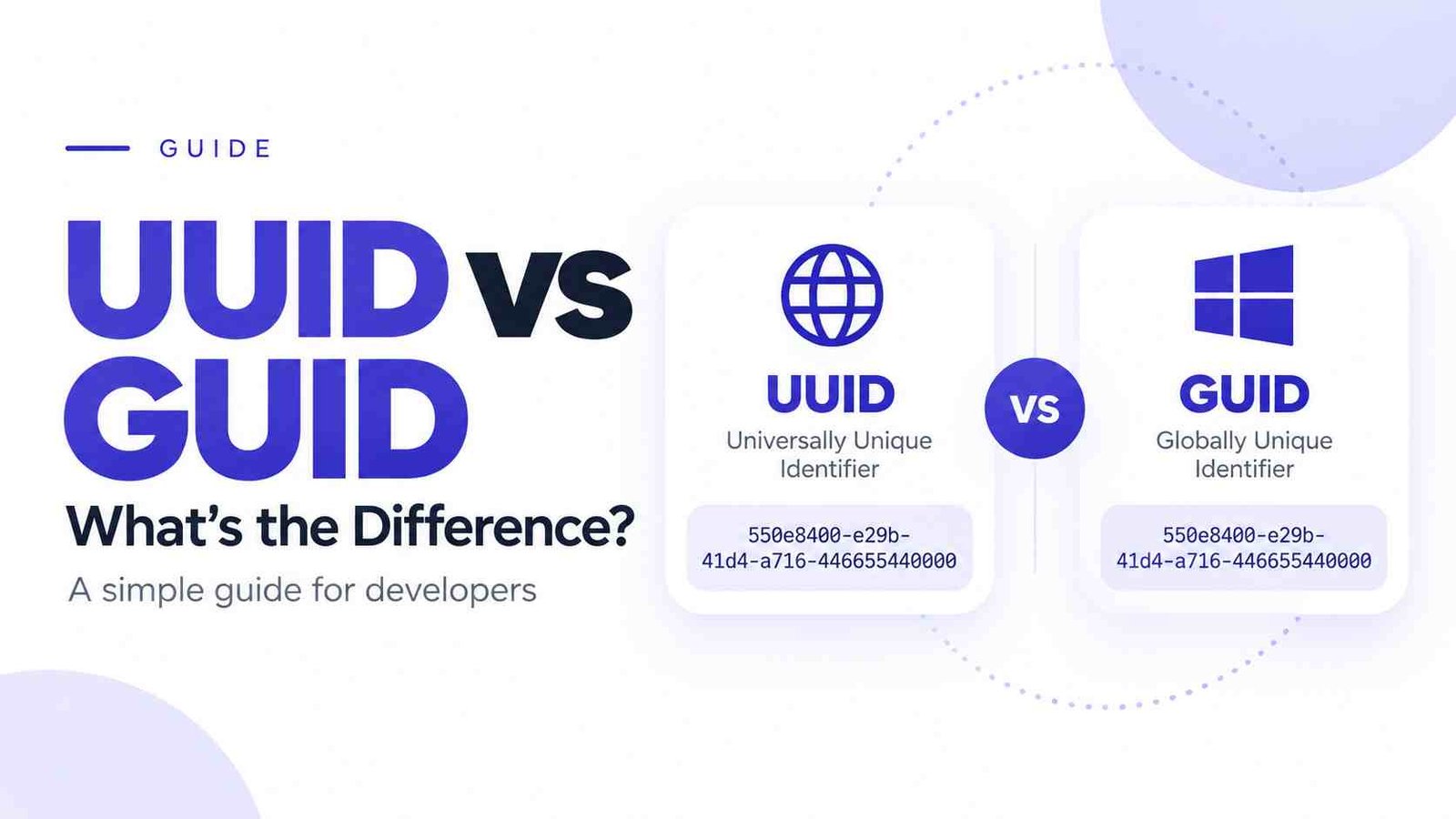
UUID stands for Universally Unique Identifier, while GUID stands for Globally Unique Identifier.
Both describe identifiers designed to provide practical uniqueness across systems.
A typical UUID/GUID looks like:
550e8400-e29b-41d4-a716-446655440000
The key difference is where the terminology is commonly used:
-
UUID is the term commonly used in standards, Linux, databases, APIs, and many programming languages.
-
GUID is strongly associated with Microsoft Windows, .NET, COM, and Microsoft development tools.
-
Both represent a 128-bit identifier in the commonly used form.
-
A GUID can generally be represented using the same hexadecimal UUID-style notation.
So, for most developers:
UUID and GUID are essentially two names for the same type of identifier.
What Is a UUID?
A UUID (Universally Unique Identifier) is a 128-bit identifier designed to provide practical uniqueness without requiring a centralized system to assign every identifier.
A UUID is commonly displayed as 32 hexadecimal characters separated into five groups:
550e8400-e29b-41d4-a716-446655440000
The standard textual layout is:
8-4-4-4-12
UUIDs are widely used for:
-
Database records
-
API resources
-
Distributed applications
-
Transactions
-
Files
-
Events
-
Objects
-
Microservices
-
Software-generated identifiers
Modern UUID specifications are defined by RFC 9562, which describes UUIDs as 128-bit values and defines several UUID versions.
What Is a GUID?
GUID stands for Globally Unique Identifier.
The term GUID is especially common in the Microsoft ecosystem.
You may encounter GUIDs in:
-
Microsoft Windows
-
.NET
-
COM
-
Active Directory
-
Microsoft SQL Server
-
Visual Studio
-
Microsoft APIs
-
Windows registry and system components
For example:
550e8400-e29b-41d4-a716-446655440000
can be represented as a GUID in a Microsoft application.
In .NET, for example, the System.Guid type is used to represent GUID values.
UUID and GUID Comparison
| Feature | UUID | GUID |
|---|---|---|
| Full name | Universally Unique Identifier | Globally Unique Identifier |
| Typical size | 128 bits | 128 bits |
| Common ecosystem | General software development | Microsoft ecosystem |
| Common notation | Hexadecimal with hyphens | Hexadecimal with hyphens |
| Database usage | Very common | Very common |
| API usage | Very common | Common |
| Windows usage | Common | Very common |
| .NET | UUID concepts are supported | System.Guid |
| Basic purpose | Unique identification | Unique identification |
The important point is that the terminology does not necessarily indicate a different identifier size or purpose.
Are UUID and GUID the Same?
For most practical development purposes, yes.
The terms are often used interchangeably.
For example, you might see:
UUID:
550e8400-e29b-41d4-a716-446655440000
and:
GUID:
550e8400-e29b-41d4-a716-446655440000
The displayed value has the same familiar 128-bit identifier structure.
However, developers should still pay attention to the specific implementation, API, byte ordering, UUID version, and serialization format when interoperability matters.
Why Are There Two Names?
The terminology developed in different software and standards ecosystems.
UUID became the widely used standards-oriented term for this class of identifiers.
GUID became particularly associated with Microsoft technologies.
As a result, developers may encounter the same general concept under different names depending on the platform.
For example:
Linux / Open Source
        ↓
      UUID

Microsoft / Windows
        ↓
      GUID
This is why you may see both terms when working on cross-platform applications.
UUID vs GUID in .NET
If you're working with C#, you'll commonly use the Guid type.
For example:
Guid id = Guid.NewGuid();

Console.WriteLine(id);
The result may look like:
d2719c8e-8b6f-4f0c-a3e4-4f5e7b6a1234
Although .NET calls the type Guid, the value follows the familiar UUID-style representation.
This is one of the clearest examples of why developers often use the terms UUID and GUID interchangeably.
UUID vs GUID in Databases
Both UUID-style identifiers and GUIDs are commonly used as database identifiers.
For example, a user table could contain:
id
------------------------------------
550e8400-e29b-41d4-a716-446655440000
7b9c2a11-5f7e-4a9b-91d3-8c22b1234567
Instead of using sequential IDs:
1
2
3
4
5
UUIDs can be generated independently by different services or application instances.
This can be particularly useful for distributed applications.
However, UUIDs are larger than typical integer IDs, so database storage, indexes, ordering, and performance should be considered when choosing an identifier strategy.
UUID vs GUID: Which One Should You Use?
The answer depends primarily on your technology stack.
Use the term UUID when:
-
Working with standards and specifications
-
Building cross-platform applications
-
Working with APIs
-
Using Linux or Unix systems
-
Designing distributed systems
-
Working with databases that use UUID terminology
-
Communicating with developers across different platforms
Use the term GUID when:
-
Working specifically with Microsoft technologies
-
Using C# or .NET
-
Working with Windows APIs
-
Working with COM
-
Following Microsoft documentation
But don't worry too much about the terminology.
If a Microsoft API asks for a Guid, you're dealing with the same broad category of 128-bit unique identifiers commonly called UUIDs elsewhere.
UUID vs GUID Format
A common representation looks like:
550e8400-e29b-41d4-a716-446655440000
It contains:
550e8400
e29b
41d4
a716
446655440000
The groups contain:
8 + 4 + 4 + 4 + 12
hexadecimal characters.
The UUID version and variant are encoded into specific bits of the identifier.
Therefore, the appearance alone does not tell you everything about how the identifier was generated.
UUID Versions and GUIDs
UUIDs can be generated using different versions.
Common versions include:
-
UUID v1 — time-based
-
UUID v3 — name-based using MD5
-
UUID v4 — random or pseudorandom
-
UUID v5 — name-based using SHA-1
-
UUID v6 — reordered time-based
-
UUID v7 — time-ordered
-
UUID v8 — application-specific
When a platform uses the term GUID, the exact capabilities and version support depend on the implementation.
For modern applications where time ordering is useful, UUID v7 is an important option to consider.
UUID vs GUID vs Database ID
These concepts are related but shouldn't be confused.
Integer ID
12345
Small and simple, but generally generated through a sequence or database mechanism.
UUID
550e8400-e29b-41d4-a716-446655440000
A 128-bit identifier designed for practical uniqueness and decentralized generation.
GUID
550e8400-e29b-41d4-a716-446655440000
Another commonly used name for this general class of identifier, particularly in Microsoft environments.
Are UUIDs and GUIDs Unique?
Neither term means that collisions are mathematically impossible.
UUIDs are designed to provide practical uniqueness.
For randomly generated UUIDs, the identifier space is extremely large, making accidental collisions extraordinarily unlikely when appropriate generation methods are used.
However, UUIDs and GUIDs should not be treated as automatically secure secrets.
For example, don't use an identifier as a replacement for:
-
Passwords
-
Cryptographic keys
-
Authentication secrets
-
Session tokens
-
API credentials
Use appropriate security mechanisms for those purposes.
Can a UUID Be Used as a GUID?
In many applications, a UUID-formatted 128-bit value can be represented using a GUID type.
For example:
UUID:
550e8400-e29b-41d4-a716-446655440000

GUID:
550e8400-e29b-41d4-a716-446655440000
However, byte ordering and serialization details can matter, especially when transferring binary representations between different systems.
When integrating systems, always follow the specific platform or API documentation rather than assuming that every binary representation is identical.
UUID vs GUID: Which Is Better?
Neither is universally "better."
The choice is usually about platform terminology and implementation requirements.
If you're building a cross-platform API, UUID is often the clearer terminology.
If you're working inside the Microsoft ecosystem, you'll frequently encounter GUID.
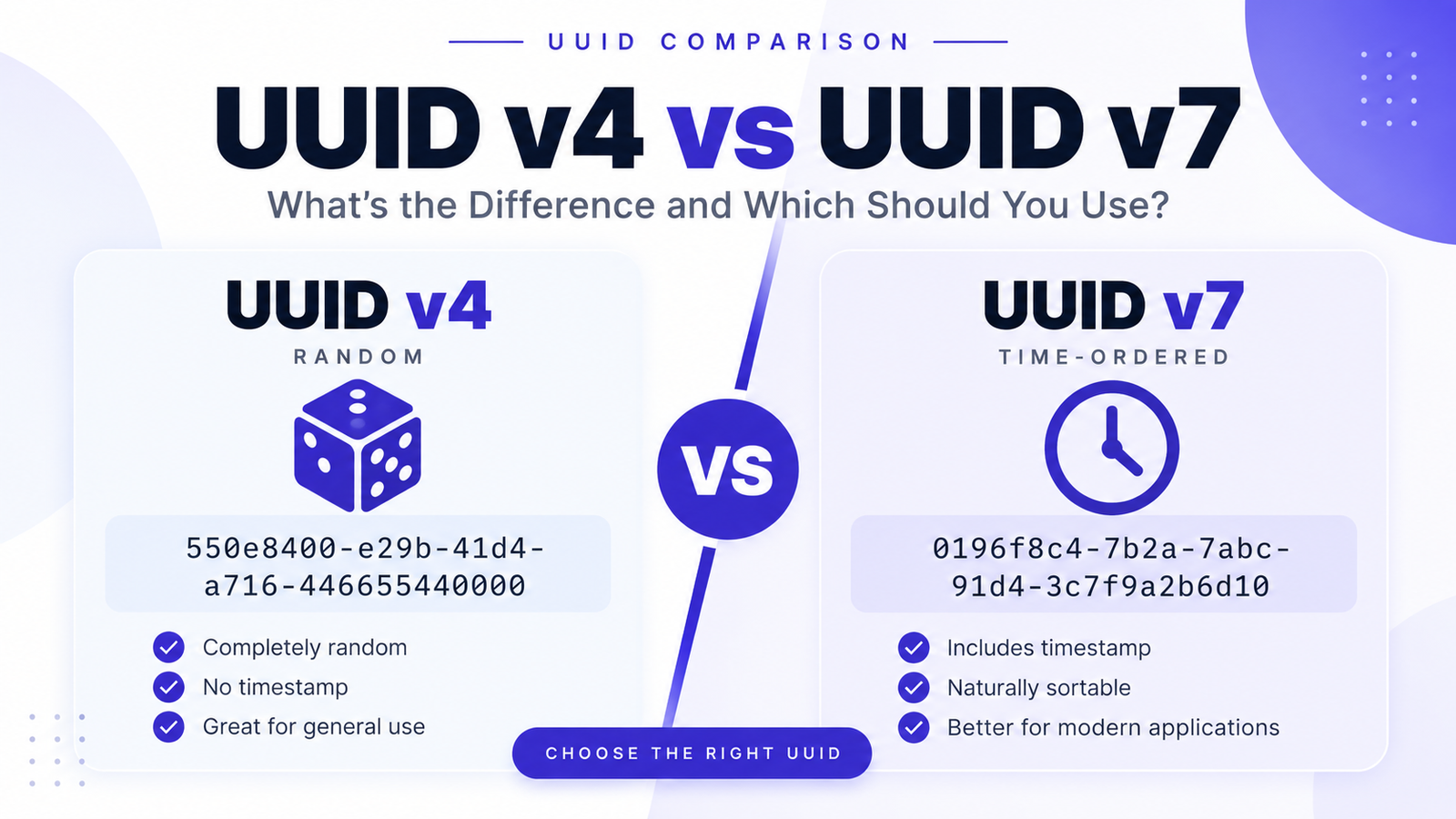
The more important decision is usually which UUID version or identifier-generation strategy fits your application.
For example:
Need a random identifier?
        ↓
UUID v4

Need time ordering?
        ↓
UUID v7

Need deterministic name-based IDs?
        ↓
UUID v5
Frequently Asked Questions
Is GUID the same as UUID?
For most practical purposes, UUID and GUID refer to the same general class of 128-bit identifiers. GUID is especially common in Microsoft technologies.
What does GUID stand for?
GUID stands for Globally Unique Identifier.
What does UUID stand for?
UUID stands for Universally Unique Identifier.
Is a GUID 128 bits?
Yes. GUIDs in the commonly used Microsoft representation are 128-bit identifiers.
Is UUID better than GUID?
No. UUID and GUID are primarily different terms used in different ecosystems. The actual identifier format and generation method matter more than the name.
Does Windows use UUID or GUID?
Windows and Microsoft documentation commonly use the term GUID, although UUID terminology is also encountered in standards and interoperability contexts.
Does .NET use UUID or GUID?
.NET provides the System.Guid type for working with GUID values.
Can I convert a UUID to a GUID?
A UUID-style 128-bit value can generally be represented using a GUID type, but binary byte ordering and serialization details should be checked when moving values between systems.
Are UUID and GUID interchangeable?
They are often interchangeable conceptually, but application APIs and binary representations may have implementation-specific requirements.
Should I use UUID v4 or UUID v7?
UUID v4 is a common choice for random identifiers. UUID v7 is useful when time ordering is desirable, particularly in modern distributed applications.
Conclusion
UUID and GUID are two names that developers commonly use for the same general concept: a 128-bit identifier designed for practical uniqueness.
The biggest distinction is the ecosystem in which the terminology is used:
UUID
↓
Standards / Cross-platform / General development

GUID
↓
Microsoft / Windows / .NET ecosystem
If you're building a modern application, focus less on whether to call the value a UUID or GUID and more on choosing the appropriate identifier version, generation method, storage format, and security model.
Need a UUID?